Wood-boring beetle remediation addresses destructive wood-destroying insects that thrive inside crawlspaces across Davidson County, where relative humidity levels routinely push wood moisture content above 16%. In…
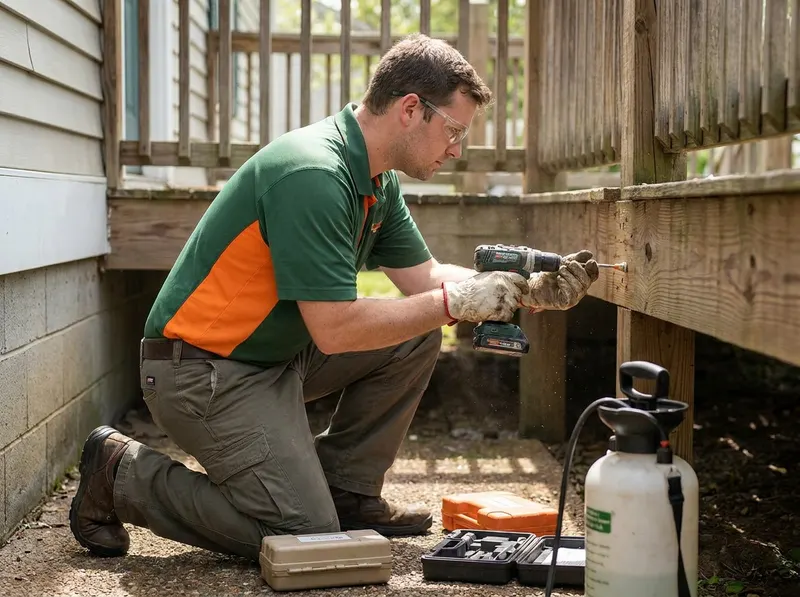
Wood-boring beetle remediation addresses destructive wood-destroying insects that thrive inside crawlspaces across Davidson County, where relative humidity levels routinely push wood moisture content above 16%. In historic brick-and-timber homes across Belmont-Hillsboro, Germantown, and East Nashville, true powderpost beetles (*Lyctinae*) and deathwatch beetles (*Anobiidae*) feed on the cellulose and starch within untreated hardwood joists. Over 3 to 5 years, larvae tunnel through interior sapwood, leaving behind pinhead-sized exit holes measuring 0.8 to 1.6 millimeters and powdery, talc-like frass. Unlike surface-active pests, wood-boring beetles spend 90% of their life cycle sequestered inside structural framing, rendering retail aerosol foggers and general surface sprays completely ineffective.
Targeted remedial care differs fundamentally from whole-structure sulfuryl fluoride fumigation. Fumigation introduces penetrating gas beneath sealed tarps to eliminate active life stages, yet it leaves zero residual defense against future re-infestation once the gas clears. In contrast, liquid borate timber restoration utilizes disodium octaborate tetrahydrate applied at an 8% to 15% active concentration directly onto unfinished wood surfaces. This natural mineral salt absorbs deeply into wood fibers with ambient moisture, killing emerging larvae upon ingestion and conferring long-term residual resistance against fungal dry rot and subterranean termites. For properties near damp drainage zones, such as Cumberland River flatlands in Donelson or protected woodlands near Radnor Lake State Park, addressing timber moisture alongside treatment is vital.
Structural moisture correction determines long-term eradication success. In neighborhoods like Sylvan Park, The Nations, and Crieve Hall, crawlspaces constructed over unsealed limestone foundations absorb ground dampness, accelerating beetle development cycles. If timber moisture content remains under 12%, anobiid beetle larvae cannot sustain metabolic activity and eventually perish. Remediation therefore couples wood mineral saturation with crawlspace vapor barrier management, sealing out external humidity to protect the load-bearing integrity of sills, headers, and primary subfloors throughout Nashville.
Every job gets a firm, written price after a free on-site visit.
Tell us about your wood-boring beetle remediation job in Nashville and we'll send a clear, written quote, usually the same day.
 Praxira Pest Experts