Nashville's native geography creates a chronic subterranean pest dynamic across Davidson County. Historic limestone foundations in Belmont-Hillsboro and Germantown sit directly over damp soil beds that retain high…
Nashville's native geography creates a chronic subterranean pest dynamic across Davidson County. Historic limestone foundations in Belmont-Hillsboro and Germantown sit directly over damp soil beds that retain high water tables near the Cumberland River and Browns Creek basin. When ground moisture evaporates beneath subfloors, humidity levels regularly exceed 70 percent, softening floor joists and attracting native subterranean termites (Reticulitermes flavipes) and wood-boring powderpost beetles. At the same time, dark, unconditioned crawlspaces beneath bungalow homes in Sylvan Park, The Nations, and Inglewood form primary harborage zones for Loxosceles reclusa (brown recluse spiders) and Norway rats. Traditional scheduled surface sprays fail because pesticide residues break down within weeks in unventilated, high-humidity crawlspaces, leaving the structural subfloor unprotected against continuous pest migration.
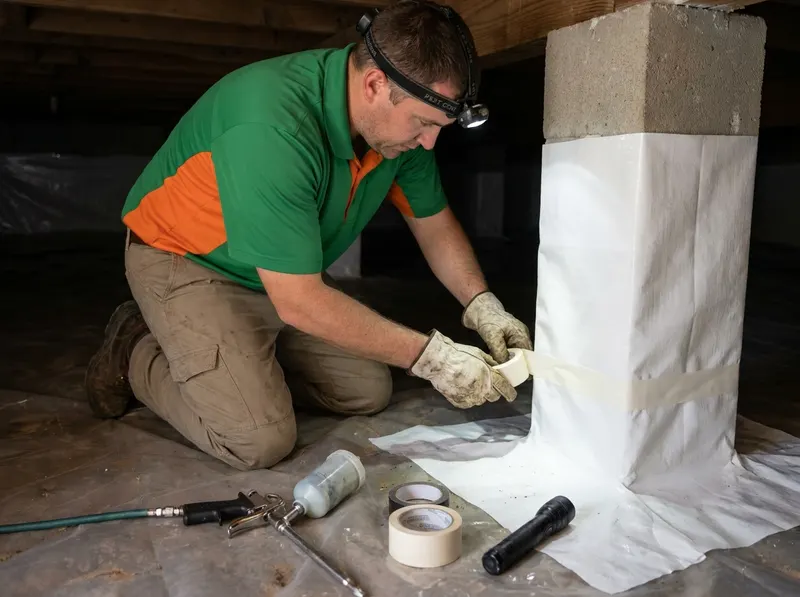
Installing an encapsulated barrier alters this biological environment by eliminating the moisture gradient pests require to survive. The process begins with clearing organic matter, regrading soil, and laying a continuous 12-mil or 20-mil cord-reinforced polyethylene membrane across the earth floor, overlapping seams by 12 inches and anchoring them with industrial masonry pins. Technicians seal the membrane 6 inches below the top of foundation walls, maintaining an unbroken termite inspection gap required by building code. Foundation wall vents are sealed against humid outside air, and structural access hatches receive compression gaskets. A low-temperature, commercial-grade dehumidifier (such as a 70-to-98-pint per day unit) is plumbed directly to the exterior to maintain wood moisture content between 10 and 14 percent, halting wood-decay fungi and driving desert-dwelling pests away from foundation footings.
A vapor barrier alone fits dry crawlspaces showing minor vapor migration, but homes with seasonal seepage, rodent burrows, or active mold require full encapsulation paired with an interior perimeter drain tile and sump pump. The trade-off between partial vapor barriers and full sealed encapsulation centers on upfront investment versus mechanical stability: a loose-laid 6-mil plastic barrier reduces ground vapor by roughly 50 percent but allows rodents to tunnel underneath, whereas an encapsulated 20-mil sealed system mechanically isolates the home from soil ecology, requires zero recurring pesticide sprays beneath living quarters, and eliminates structural entry paths into kitchens and living rooms.
Every job gets a firm, written price after a free on-site visit.
Tell us about your crawlspace encapsulation pest barrier job in Nashville and we'll send a clear, written quote, usually the same day.
 Praxira Pest Experts