Brown recluse spiders (*Loxosceles reclusa*) thrive within Middle Tennessee's native limestone topography, finding shelter inside structural framing, stacked stone foundations, and ventilated attics. Traditional…
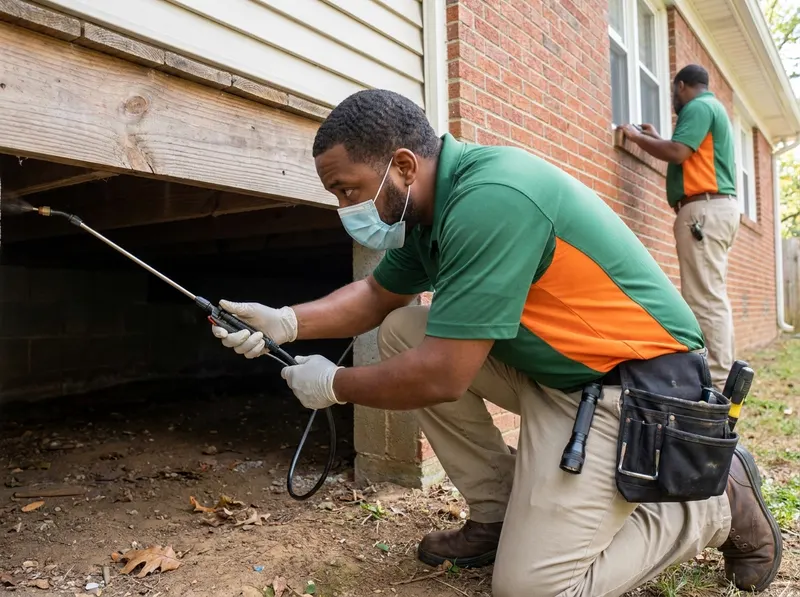
Brown recluse spiders (*Loxosceles reclusa*) thrive within Middle Tennessee's native limestone topography, finding shelter inside structural framing, stacked stone foundations, and ventilated attics. Traditional perimeter surface sprays often fail because brown recluse spiders carry their bodies elevated above treated floor surfaces on long legs, reducing contact with residual liquid films. Eradication requires precise mechanical and chemical placement: insecticidal silica dust injected into unsealed drywall voids, residual microencapsulated suspensions along dark baseboards, and granular or specialized aerosol treatments in unfinished storage rafters. The trade-off between aggressive broad-spectrum fogging and void-injected dusting is clear: space fogs quickly push recluse spiders deeper into wall cavities and ceiling insulation, while targeted void dusting treats the dark harborages where spiders actively hide without displacing them into primary living areas.
Older homes with fieldstone and rubble foundations in neighborhoods like Belmont-Hillsboro, Sylvan Park, and Germantown present deep mortar voids that act as primary harborages, requiring high-pressure micro-dusting along sill plates. In heavily wooded tracts near Belle Meade, Green Hills, and Crieve Hall, outdoor populations regularly migrate across tree canopies into ridge vents and soffits. Properties constructed over damp dirt crawlspaces in Inglewood, Donelson, East Nashville, and The Nations demand perimeter moisture reduction alongside focused barrier applications to eliminate the moisture-loving insects brown recluses hunt.
Complete population knockdown typically requires two to three treatment cycles spaced 30 to 60 days apart, accompanied by physical monitoring boards. Glue boards capture foraging males and measure population density over time, verifying whether newly hatched spiderlings emerge from untreated insulation caches. Structural remediation, such as sealing crawlspace access hatches, installing fine-mesh screening over attic gable louvers, and trimming vegetation 24 inches back from siding, prevents re-entry from adjacent wooded habitats.
Every job gets a firm, written price after a free on-site visit.
Tell us about your brown recluse spider eradication job in Nashville and we'll send a clear, written quote, usually the same day.
 Praxira Pest Experts